

How to Sell Your Ebook Online (Without Building a Whole Funnel)
You don't need a 17-email launch sequence to sell an ebook. A simple paid page with real social proof outsells a complex funnel for most authors. Here are the three ways to do it.

Somewhere along the way, "sell an ebook" turned into "build a funnel."
A lead magnet to capture the email. A welcome sequence to warm them up. A tripwire. An upsell. A downsell. A 17-email launch runway with a countdown timer and a cart-close deadline. A "value ladder." By the time the funnel is built, the ebook's been done for three months and you've sold four copies — to people on your list who'd have bought it anyway.
You don't need any of that.
For the vast majority of authors, a simple paid page — clear promise, a few honest reviews, a buy button — outsells the elaborate funnel. Not because funnels don't work, but because the funnel you actually finish beats the funnel you're still building. And most people never finish the funnel.
Here's how to sell your ebook this week instead of launching it next quarter.
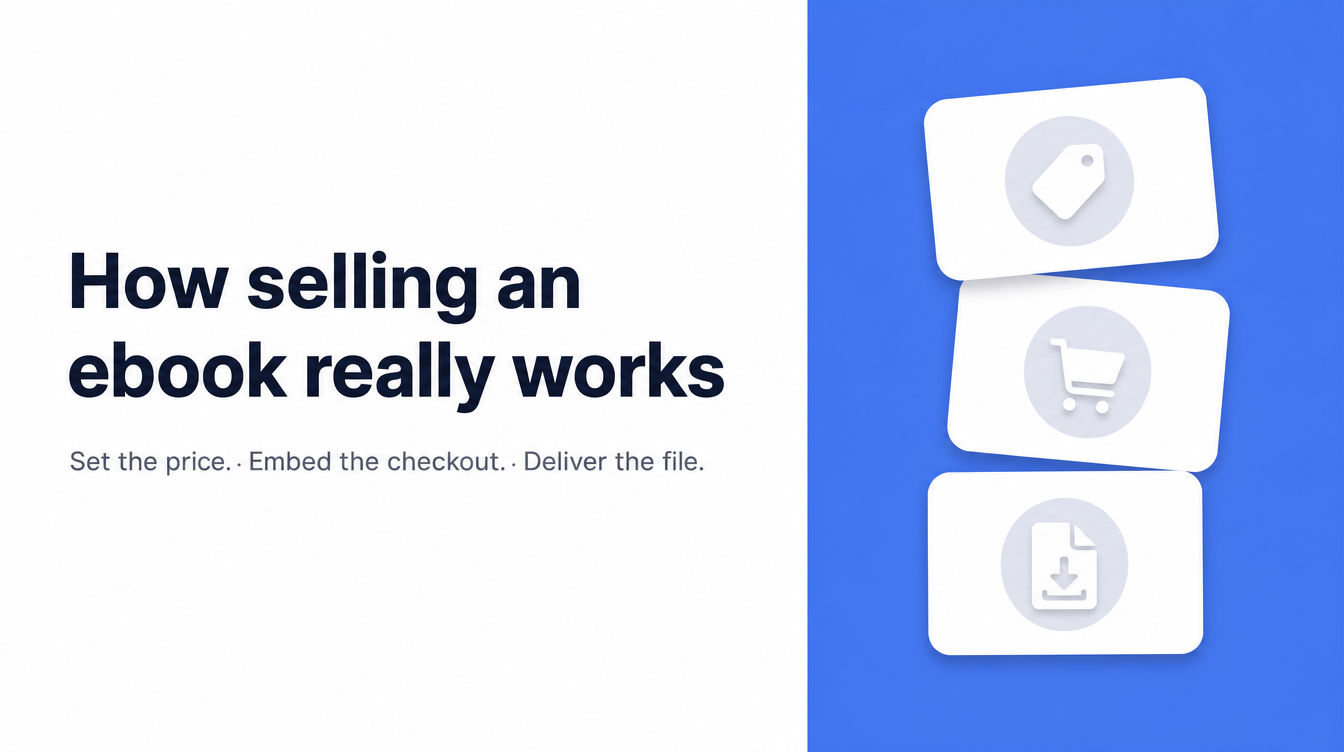
How selling an ebook really works
Three things have to be true:
- You have an ebook, or content that's most of the way to one. (A long guide, a series of posts, a workshop handout — that's a draft.)
- You have somewhere to send buyers. (Your website, your email list, your social following — even one is enough.)
- You're willing to charge for it. (The hardest one. We'll get to it.)
That's it. No funnel. No launch team. No email-automation degree.
Why most ebook funnels are overengineered
The funnel advice exists because it's what worked for someone selling a $2,000 course to a 50,000-person list. You are not running that play.
When you have a modest audience and a $19 ebook, every extra step in the funnel is a place people leak out. The lead magnet collects emails from people who wanted the free thing, not the paid thing. The nurture sequence trains them to wait for a discount. The cart-close deadline feels manufactured because it is. Each step adds work for you and friction for them.
A direct paid page does the opposite. The people who land on it already want what you're selling — you don't have to manufacture desire across eight emails. They read the promise, they see that other people found it useful, they buy or they don't. Clean.
The honest math: a funnel might convert better per visitor who completes it — but almost nobody completes it, and you burn a month building it. A simple page converts a smaller slice of a warmer audience, ships in a day, and earns immediately. For 90% of authors, the simple page wins on total dollars — and most authors never finish the funnel anyway, the same trap that keeps nearly half of course creators from ever hitting publish.
Save the funnel for version two, after the ebook is already selling and you know it converts. (If you want proof it'll sell before you finish writing, you can pre-sell it first — take the orders, then deliver.)
The three ways to sell it (pick one)
All three skip the funnel. Pick the one that matches what you already have.
Path 1: Embed a buy button on the site you already have
If you've got a website with traffic — a blog, an about page, a coaching site — the fastest path is to sell the ebook right there. Create the ebook as a digital product, grab the embed code, and drop it onto a page you already own. Visitors read about it and buy without leaving your site.
This is the same move as embedding a course on your existing website — same idea, same paste, just a digital product instead of a course. If your site already gets visitors, this is the highest-leverage option, because you're selling to traffic you already have.
Path 2: A single landing page with a buy button
No website, or you'd rather keep the ebook separate? Spin up one dedicated page. A headline that states the promise, a few paragraphs on what's inside and who it's for, two or three real reviews, and a buy button. That's the whole page.
MLA auto-generates this landing page for every product you create — hero, description, checkout, all of it — so you're not designing a sales page from scratch. You point your link there: one URL for your bio, your email signature, your next podcast mention. One page does the whole job.
Path 3: Bundle the ebook with a course
The highest-value play: don't sell the ebook alone — make it the companion to a course. The course teaches the thing; the ebook is the reference they keep. Bundled, the ebook stops being a $19 impulse buy and becomes part of a $97 offer that feels complete.
If you don't have the course yet, it's a weekend of focused work — and the ebook you already wrote is a head start on the outline. This path earns the most per buyer, because you're selling a transformation, not a file.
How to price it
Most authors underprice their ebook into the ground. $0.99 to $4.99 is romance-novel pricing — fine for fiction you sell 10,000 copies of, wrong for expertise you sell 200 copies of.
Price on the value of what the reader walks away with, not the page count. A 30-page ebook that saves someone ten hours or makes them their first $1,000 is worth $19, $29, $49 — not $2.99. The thin-pricing instinct costs you more than it earns. Ten sales at $29 beats a hundred at $2.99, and the $29 buyer takes it more seriously.
We pulled the actual numbers on what creators charge — the same logic applies to ebooks. Start higher than feels comfortable. You can always discount; it's much harder to raise a price you've anchored low.
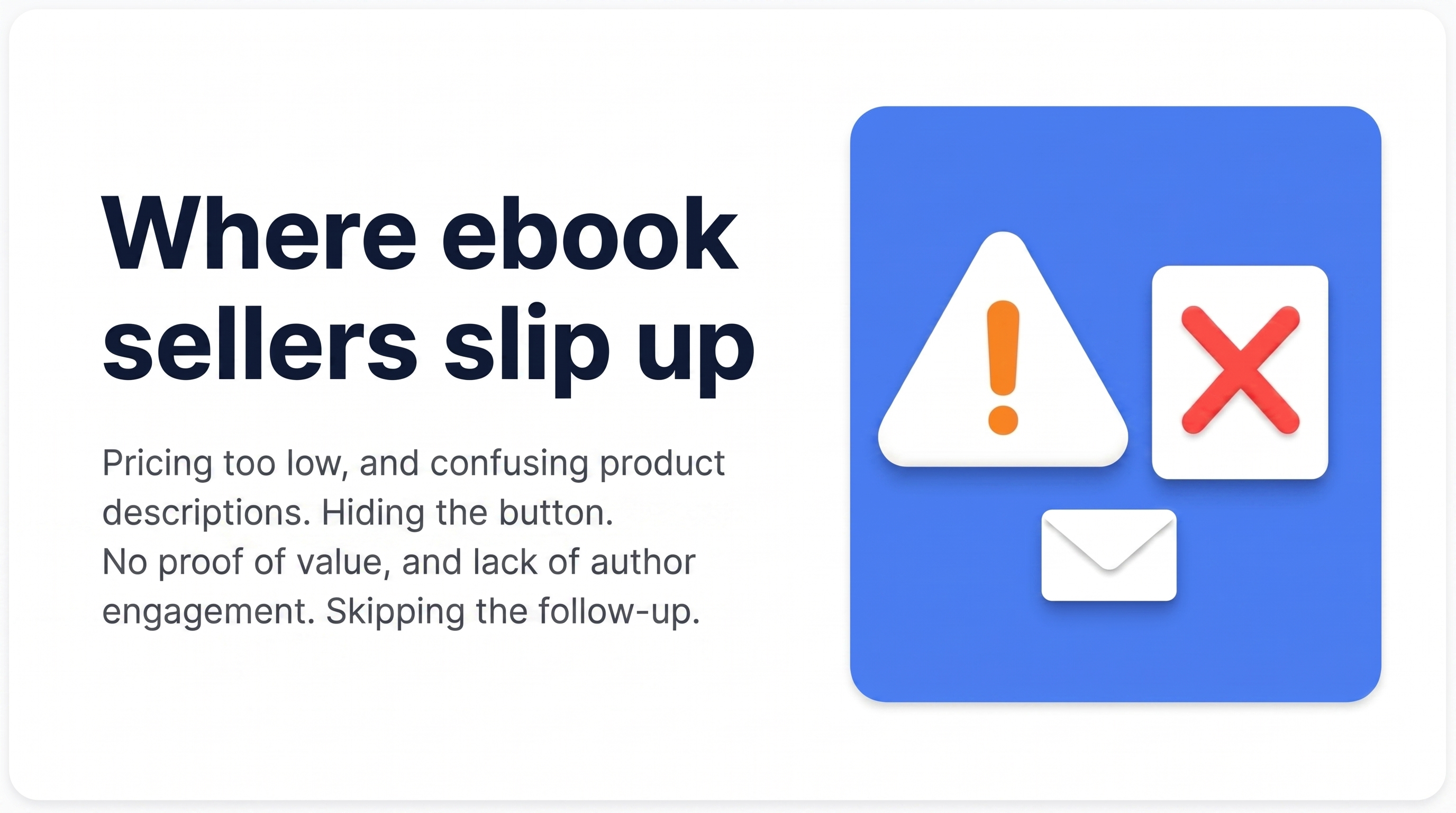
Where ebook sellers slip up
Waiting for the "launch." There is no perfect launch day. Put the buy button up, tell the people who already follow you, and let it sell. Momentum beats timing.
Writing a 4,000-word sales page. Your buyers don't read it. State the promise, show a few proofs, give them the button. A short honest page outperforms a long hyped one at this price point.
No social proof. This is the one that actually moves the needle. Two or three real reviews beat any amount of copywriting. If the ebook's new, send free copies to five people whose opinion your audience trusts and ask for an honest line back.
Handing your buyer to Amazon. Sell through Amazon KDP and you keep a fraction, you can't see who bought, and the reader becomes Amazon's customer, not yours. Selling it yourself means you keep nearly all of every sale and you own the buyer relationship — worth more than the margin.
What this won't do
This isn't a guide to gaming Amazon's Kindle algorithm, stacking a launch to hit a bestseller badge, or building a 12-part automated funnel with a sales coach on retainer. Those are real strategies for people whose whole business is publishing volume.
This is the guide to selling the ebook you already wrote to the audience you already have — directly, simply, this week. Gumroad will take a cut and a flat fee per sale. Payhip will host it. Amazon will rent you their audience and keep most of the money. All of them work. But if you've already got somewhere to send people and something worth charging for, you don't need a funnel or a marketplace to start selling.
Once it's selling, then add the funnel, the marketplace, the launch. Most authors who try to build all that first never publish anything.
If you remember one thing
Turn your ebook into a digital product. Pick one of three paths: embed a buy button on your existing site, spin up one landing page, or bundle it with a course. Price it on the value of the result, not the page count — $19 to $49, not $2.99. Add two or three real reviews. Tell the people who already follow you. Skip the funnel until it's already selling.
That's the launch.
Common Questions
"Do I need my own website to sell an ebook?"
No. A single landing page with a buy button does the whole job — put the link in your bio and email signature. A website helps because you can sell to existing traffic, but it's not required to start.
"What format should the ebook be?"
PDF is the safe default — everyone can open it, it keeps your formatting, and it delivers instantly after checkout. EPUB is nice for e-readers but adds friction for most buyers. Start with PDF.
"Can I turn the ebook into an audiobook too?"
Yes — and it's an easy second product. MLA can narrate your ebook in your own voice (via voice cloning) or a clean default voice, so the same content sells twice: read it or listen to it. Here's how the audio side works.
"How do I deliver it after someone pays?"
Automatically. When you sell through a platform that handles checkout, the buyer gets instant access the moment they pay — no manually emailing files. That's the whole point of selling it as a product instead of DMing PDFs.
"What if I haven't written the ebook yet?"
You're closer than you think. A long guide, a webinar, a series of posts, a workshop handout — that's a draft. You can drop existing content in and restructure it into a finished ebook faster than starting from a blank page. (Not sure whether to start fresh or repurpose what you have? Here's how to decide.)
"Should I sell it on Amazon instead?"
Amazon gets you discovery you don't have to earn, but you keep a fraction of each sale and never learn who your readers are. Selling direct keeps the money and the relationship. Many authors do both — direct to their own audience, Amazon for reach. If you've already got an audience, start direct.
"How much should I charge?"
More than feels comfortable. $19 to $49 for an expertise-based ebook is normal; the value is in the result the reader gets, not the length. Underpricing signals "this isn't worth much" — exactly the wrong message.
The ebook sitting in your drafts folder could be earning by the weekend. Start a free trial of Mini Lessons Academy, turn it into a product, and put a buy button on it — no funnel required.
Recommended Reading
You might also be interested in these related articles
How to Turn Your Course or Ebook Into an Audiobook Without Recording
Audio is the format most creators skip — and the one their audience consumes on the move. Here's how to turn a course or ebook into narrated audio without a microphone, a studio, or a single retake.
Read moreHow Agencies Use Online Courses to Onboard Clients and Scale
Agencies repeat the same explanations to every client and every new hire. A course captures that knowledge once — speeding up onboarding, standardizing the work, and even opening a new revenue line. Here's how.
Read moreMini Lessons Academy vs Kajabi vs Teachable: An Honest Comparison
Three popular ways to build and sell a course, three different philosophies. Here's an honest look at who each one is actually for — including when one of the others is the better pick.
Read more